Showing posts with label climate change. Show all posts

Tuesday, January 15, 2008

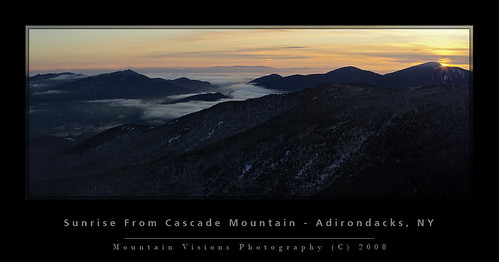
3rd Time Is The Charm: Sunrise On Cascade Mountain

After 3 consecutive weekends of searching for a sunrise, I finally got one.

In my pursuit of sunrises, I am finally getting my fat ass in shape. After being in great shape to end the summer, my back was bothering me in October, nothing ever happened, but there is a feeling that anyone with disc issues knows, and I had it, causing me to put off my second 10 day paddling trip. It worked out because it rained torrentially for almost all 10 days.

I'm not a fair weather paddler or hiker, but 10 days of pouring rain is depressing, and even after my back was feeling like it wasn't an issue I bailed out and decided on work rather than waste a week.

Nevertheless, good intentions and excitement for winter turned to getting lazy as the winter was slow to arrive. Fitness is fleeting and once it's gone it's a pain in the butt to get it back. I'm going to venture to say, despite working out hard in November, by Jan 1st I was in the worst fitness I've ever been in.

So very slowly I am working my way into shape by chasing sunrises up some of the smaller Adirondack peaks, each one getting progressively harder (or easier if you look at it from a fitness standpoint).

Enough with the discussion of my seemingly 50 year old cardiovascular system, my weak muscles, and Krispy Kreme physique.

Sunday, I left home at 3:20am and got to the Cascade trail head at 4:55am.

After putting on my boots and gaiters, and making sure I didn't forget anything, I was on the trail by 5:20am.

I started to leave my snowshoes at the trail head, but since I took them I decided to wear them rather than lash them to my pack along with my 9lb tripod, and crampons. Big mistake! After about 2 minutes the trail turned to rock and mud. So I was forced to hike in the trees which was not too troublesome. The forest to Cascade is uniquely thin for the Adirondacks, and bushwhacking (albeit only meters from the trail) is relatively fast and unencumbered.

Walking on the frozen snow was like walking on styrofoam. No powder to be found in the Adirondacks after a week of record temps and rain.
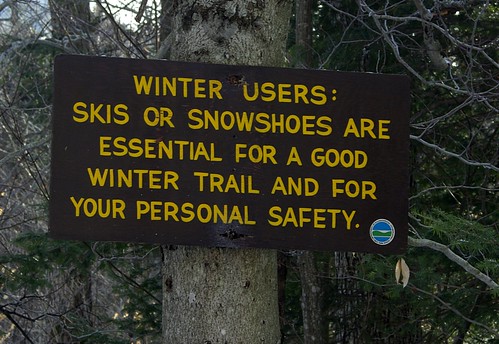
At about 3000ft, approx 900 vertical feet from the trailhead, the snow coverage was more consistent and it was back on the trail full time. By 3500ft there was snow covering all of the ground for the first time.

The hike was under a star filled sky, which occasionally found me turning my headlamp off just to take in the starlight.

At about 3700ft there is a steep rock section which in a typical winter is covered with deep snow till the top of the slab where it is a sheet of 20* ice. Unfortunately, despite the great December, the mountains resemble early November rather than January.
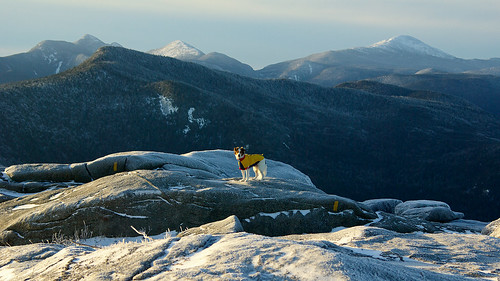
At this point I removed my snowshoes, and put on my crampons, with the snow being rock hard and bulletproof, I ditched my snowshoes deep in the trees and hiked the rest of the way in crampons.
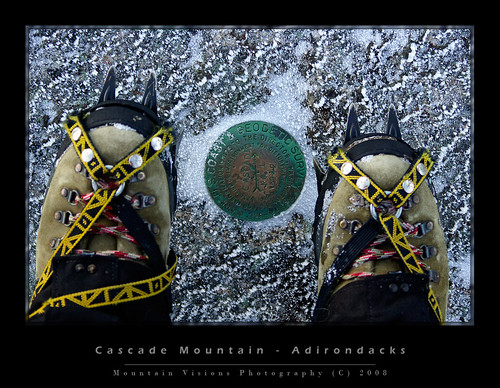
The summit of Cascade is a long fairly flat ridge, although somewhat slightly technical with a few scrambles to get to the high point. It's a typically non nondescript Adirondack summit that is often considered the easiest 4000 footer in the Adirondacks. It's not that Cascade is not a pretty summit, it actually reminds me of a mini Mount Mansfield when you come out of the scrub line on Sunset Ridge with the big expanse of exposed ridge, but it's not a conical summit like most people envision most summits to be.

What can't be minimized are the spectacular views which take in almost all of the 4000ft peaks.

I got to the summit at 7:15, although it's a bit deceiving as I wondered if stopping to photograph lower would have been better, I wasted a few minutes evaluating vantage points. For some reason I've always liked the views below the summit much better than on top.

After 45minutes up there, in what was an unusually windless day, and actually fairly warm in the sun, we headed down and I considered hiking to Porter Mountain about .7 miles further.
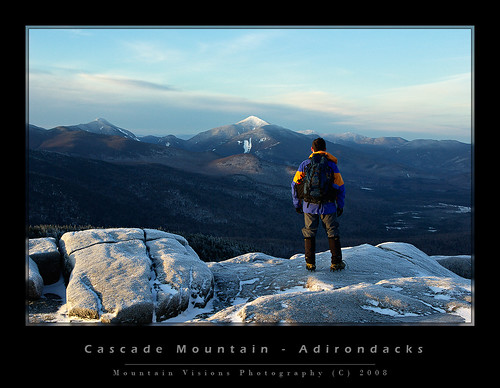

I started down the trail to Porter but about 5 minutes into it I turned around. Unfortunately while I felt great, my heels had blisters (feet need to get in shape too), and I decided to head down.

The hike out was uneventful. Other than of course the typical weekend hordes that hike to Cascades summit. The solitude of 5am starts suit me, but it's always nice to talk to a few people on the way down, and more so with the smug satisfaction of knowing it's around 8am and you are done with the day!!! In all about 12 people were hiking up on my way out.
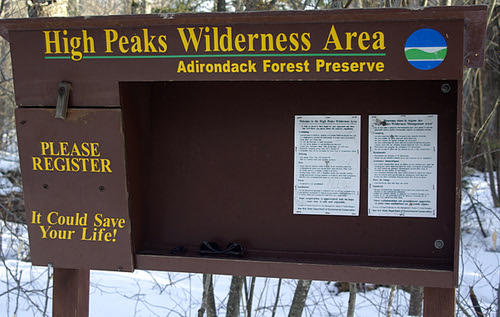
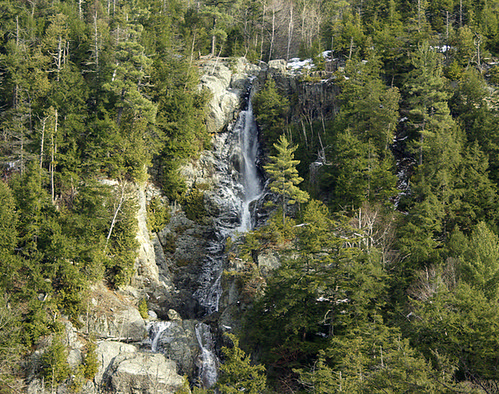
There is no such thing as a bad day in the mountains, but it's occasionally nice to see the sun rise, to see blue in the sky, and to see a few feet in front of your face. What was sad was the drive home through the mountain passes. Typically filled with waist deep snow, frozen ponds, and ice covering the cliffs, which in turn are covered by ice climbers. Instead it looked like late fall or early spring. Had I been in a coma for the last few months, I'd have guessed it was November.

technorati tags:, , , , , , , , , , , , , , , , , , , , , , , , , , , , ,

Wednesday, October 3, 2007

Going Vertical In The St. Regis Canoe Area


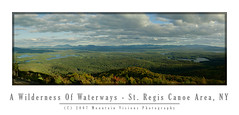
The St. Regis Canoe Area (STRCA) is a pond hoppers paradise. Having 58 ponds in 18,000 wilderness acres, the area has short -but plentiful- portages.

Out of the boat for a weekend we headed for Paul Smith's in the Northern Adirondacks which is just outside the eastern boundary to the STRCA. The goal was either a sunrise or sunset summit and we opted to leave home at around 12pm and watch the sunset.


We had great weather, although it was a bit chilly. Low 40s on the summit with a consistent 10mph breeze.

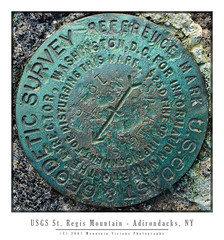
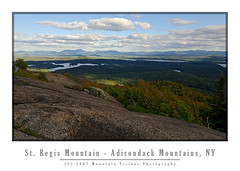
St. Regis Mountain is on the northern border of the STRCA and offers a commanding view of the "wilderness of waterways" below, as well as a nearly 360* view of the northern Adirondacks.


The hike in is a rolling 3.5 mile walk that goes vertical for the last 1 mile gaining most of the nearly 1300ft in that abbreviated stretch.

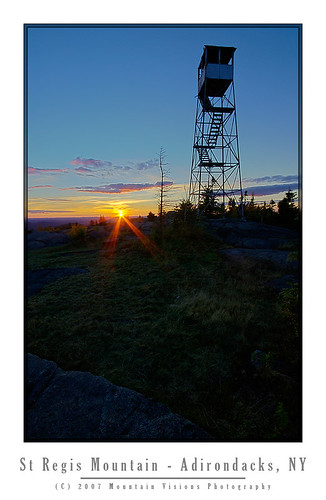
Although St. Regis summit has a fire tower, it is neither open, climbable or barely standing at this point.
 

In the States master plan and Unit Management Plans (UMP) fire towers are a grey area. The state temporaliy grandfathered them into the wilderness areas until the aerial fire survalence and modern communications systems were up and running at 100%. It has been some time since 100% operational status has been reached, and a decade or more since the last fire tower was last staffed. However, the St Regis firetower has been left to be an eyesore and eventually fall to the ground.

My feelings are if the State/DEC/APA feels it needs to go then tear it down and fully remove it from the summit. If it wants to keep it then let a private group restore it as has been done on the other towers in the non wilderness areas.

However, the current state of purgatory this tower is in is a disgrace. Barely standing, and with no lower laddering to even allow people to ascend part way like most closed towers allow.

Personally, I don't believe these belong in wilderness areas. However, I also don't have a major problem with them if they are restored. Regardless, a decision on the status of this tower would be appreciated.


Blogged with Flock

Thursday, May 24, 2007

Moreau and The Red Eft

Took my first hike Sunday and everything went well. We took the West Ridge Trail which has some interesting rocky view points. Trail was moderate and really perfect for a first hike.

With rain impending we were just happy to get a few miles in and we ended up hiking out in the pouring rain, but it was a good hike.

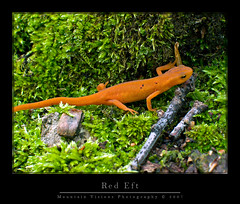
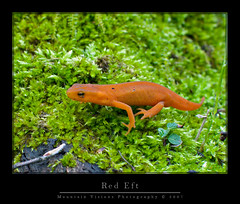
Along the way we came across these Red Efts (spotted newts). These are pretty common in the northeast in the spring despite the fact they are far less plentiful then decades ago. Global warming/climate change? Pollution? Ozone layer depletion (responsible for many amphibians extinction)? Whatever the reason these guys going the way of the dodo and fewer and fewer seem to be seen every spring.

While I've quite a few photos of Red Efts on leaves, these are unique because of the green moss.

(To view the full size photos, click on the thumbnails below)

technorati tags:, , , , , , , , ,

Blogged with Flock

Sunday, April 15, 2007

Step It Up 2007


All photos (C) Justin Serpico 2007

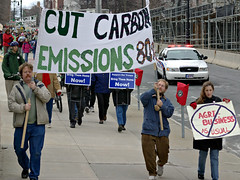
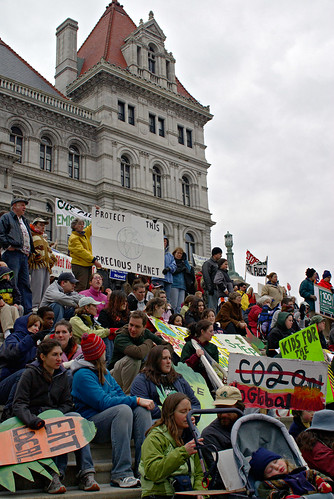
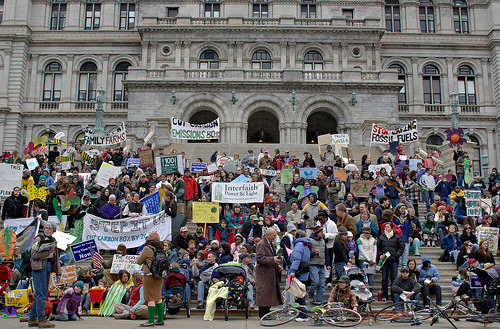
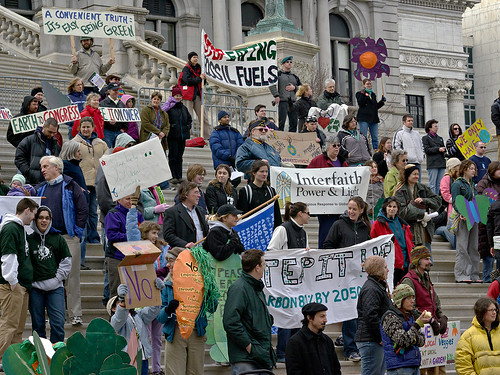
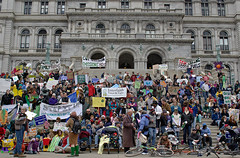
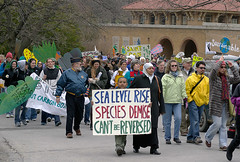
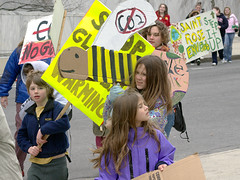
The first annual "Day of Climate Action" swept across the nation on April 14th, with over 1350 rallies to urge congress to enact sweeping changes to reduce carbon emissions 80% by 2050.

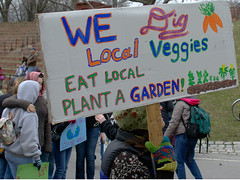
While the rally was aimed at affecting national policy change, there was a tremendous emphasis on micro change. Farmers and activist spoke about the benefits of buying food grown by local farmers and ranchers.

It's well known that people don't feel like they have an individual impact on reversing global climate change, and Step It Up 2007 was aimed at changing this feeling.

Little things like switching from incandescent light bulbs, insulating a house properly, switching to alternative energy to at least partially power a house, buying locally grown produce and meats are all ways to reduce carbon emissions.

While in urban areas completely powering a house using green energy might be impossible, it is possible to reduce carbon consumption. Using solar energy to heat the homes hot water supply is a simple and prove approach. In some areas entire housing communities are using geothermic hot water. This water still needs to be heated but it is already much warmer coming up from the ground then traditional incoming water. This reduces energy cost and carbon emissions.

The future of home energy consumption, which puts more carbon into the air then an SUV per year, is reducing grid obtained energy and making each home more energy efficient so that each little bit of energy the homeowner can produce, whether it be solar, wind, geothermal, or other sources will have a greater impact.


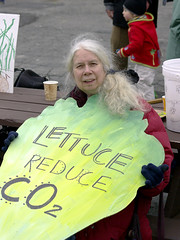
Food is another example of carbon pollution with a simple fix. The fact that it takes 36 calories of fossil fuel to transport 1 calorie of lettuce across the US is an example of how much carbon is emitted to feed this country. Most people probably never considered the impact of buying foods trucked in from far away on global warming.

Buying local foods reduces the amount of fossil fuels required to transport food, as well as supporting local growers, and keeping open space in your region.

The majority of our foods are trucked in from central locations, or from places with long growing seasons like California or Florida. Small farmers in the northeast are under extreme pressure to sell their land for development, while the nation has moved to more of a big box food supply economy.

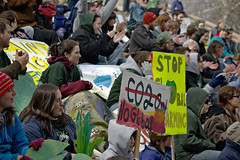
In a push to show the quality and diversity of local foods, the Honest Weight Food Co-op of Albany, sponsored a free picnic in Washington Park prior to the march to the New York State capitol. The picnic was a showcase of local growers, with everything from free range BBQ chicken and tofu, to local produce and dairy available.

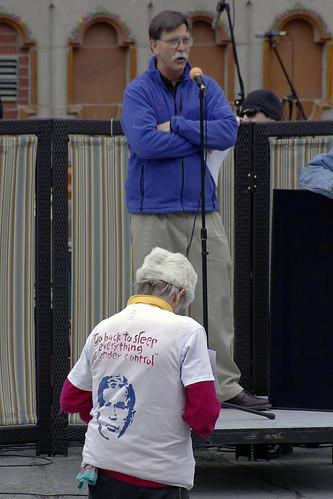
Following the march to the capitol local farmers, politicians and activist spoke about the individuals role in global climate change while pushing for national policy change.

JS


technorati tags:, , , , , , , , , , , , , , , ,

Blogged with Flock

Thursday, April 12, 2007

Step It Up 2007: National Day Of Climate Action

Australian Students stand up to fossil fuels!

Photo: (c) itsgettinghotinhere.org


Saturday April 14th is the first National Day Of Climate Action.

It's the first step in a national movement to reduce carbon emissions by 80% by 2050.

It's the first step in national awareness of the rapid warming of the planet. Similary to the first Earth Day in 1970 it's designed to promote awareness and action.

Despite holes and oversimplification in Al Gore's, Inconvenient Truth, the documentary served as a main stream education to the masses of the reality of climate change. Now it's time to take it a step further and push for enaction of national energy policy change and break the nations addiction to foreign fossil fuels.

There is certainly a rally in your area. And if not it might not be too late to put something together to bolster awareness, and show your elected officials that this isn't something you are willing to sit back and watch them twiddle their thumbs on.

JS

Visit: Step It Up 2007 for more information

http://stepitup2007.org/


Aengus and Tom Gillespie

Tom Gillespie, right, and his son, Aengus, show off their banner
urging action against global warming Tuesday in Albany.
(Steve jacobs / Times Union)


technorati tags:, , , , , , , , , , , , , , ,

Blogged with Flock

New York Welcomes Global Warming Change

Aengus and Tom Gillespie
Tom Gillespie, right, and his son, Aengus, show off their banner
urging action against global warming Tuesday in Albany.
(Steve jacobs / Times Union)


While nothing in science is generally ever 100% agreed upon, the fact that the ma
jority of the worlds scientist don't contest the fact that the earth is warming is a bit scary.

Sure they differ on what the results will be, how far we can go before the inertia of nature is shifted, but they don't contest it's happening, or that we are better off stopping it before finding out what the results will be.

We know that coastal areas will be devastated. If the ice caps melt it will at the very least increase water volume and erase some of the coast. It will affect growing seasons, rainfall, jetstreams, and gulf streams. The results of which are modeled but uncertain at best.

The ocean temperature is largely responsible for our global climate as long as it stays within a range that doesn't vastly differ (and that range could be just a few degrees or less) we should be able to correct our climate change. If it changes too much we will lose our inertia and lose the battle on global warming.

However, shifting the inertia of the ocean in any direction is hard to do. The reason is the ocean is a huge amount of the earths stored heat. It averages 13,000ft deep and to heat or cool all that water will take some time. If we shift the direction of that heating or cooling too much we will be in serious climatic trouble.

Inertia is a key word in "Global Warming" once we shift it so far off it's course it will be impossible to correct it. There is no definite degree of temperature increase that would be the point of no return at this point, but scientist agree that we don't want to find that point.

Right now the environments, and oceans, inertia is still in our favor according to most scientist. If we act now and act fast we can keep it from shifting in a direction that we will not be able to fix

The scariest part of all of this to me is the fact that in the US we don't care, well, not enough to change.

Congress is completely inept. Not in the usual way, but in the fact that they are lawyers and politicians and simply don't understand the things scientist are telling them. If you watch the C-Span congressional hearings of scientist, and even Al Gore, it's clear that congress has not a clue as to what to do. The only question they know to ask is "how much will it cost".

Our national lawmakers seem completely confused even as the scientific dogma is sliced so thin that even a child with a 8th grade education could easily digest it.

Weaning the nation from wasteful ways, and an addiction to fossil fuels will be tough and expensive, but a more effecient energy plan will save money. Ultimately less dependence on foreign oil will save money in both real dollars, global security, and will eliminate the speculative uncertainty of the price of foreign energy which unfortunately has more to do with energy cost then the actual value of the fuel we use.

Higher effeciency will mean lower cost and more stable economies. In a nation where the bottom dollar is the most important thing that will be the most influential argument to facilitate changing our policies.

JS


To take part in the fight against the "do nothing and hope for the best" policies of our government on April 14th (and beyond), visit:

Step It Up 2007: A National Day Of Climate Action

And Remember That Uncle Sam Loves Fossil Fuel So If You Do Nothing, Nothing Will Happen.

fossil_fuels.jpg

Scientists turn up the heat in climate debate
Global warming rally planned for Troy is one of 1,300 across the U.S.

By BRIAN NEARING, Staff writer
First published: Wednesday, April 11, 2007

"Scientists are being treated as the authorities for this issue," said Bystroff, who is among 20 RPI scientists involved in planning the Troy rally.

"Let me dispel any notion that scientists all think alike. They like to argue among themselves, and that is why the convergence of opinion on climate change is quite astounding. That there is real controversy remaining over the science behind the climate change has been exaggerated."

......

"A decade ago, McKibben wrote "The End of Nature," the first general-interest book on global warming by an American.

Last year, his family ate only food grown near his home in the Champlain Valley of New York and Vermont as a way to reduce the transport of food across vast distances.

McKibben said 36 calories of fossil fuel energy are consumed to transport one calorie of nutrition from iceberg lettuce from California fields to East Coast supermarkets.

"The reality that we are faced with now is that our government has been reluctant to get involved to fight global warming," said David Yarrow, director of the Regional Farm and Food Project.

"Since we live in a democracy, it is only the voice of the citizens that can provoke the government into action," he said.

"This is our first attempt to make this a national issue. We need to stop contributing to climate change, then we can figure out how to adapt to the changes that are already coming."

Albany, N.Y.: Timesunion.com - Print Story


Blogged with Flock