Wednesday, June 9, 2010

Legislature Successfully Defends Paterson's Assualt On EPF

The following is not without some negative. The legislature did in some ways gut the EPF, but it didn't allow David A. Paterson to milk the EPF to cover his shortcomings as a leader. The legislature prevented him from using the EPF as a rainy day fund for the states day to day expenses, which was his initial goal.

The bottom line was that they cut about $78 million out of the EPF to fund the $11 million it (supposedly) cost to reopen the state parks and campgrounds that were closed.

I'm the first one to admit I'm not super smooth at math, but something isn't right. Basically Paterson held the NY State Parks as hostages while he demanded the funds from the EPF. So what he did was he said, the park system, which saw record visitation last year (and I'll assume near record revenue, or I'll again assume probably broke even in expenses) was too expensive to run, so if the legislature wanted to appease it's constituents it would have to deal the EPF.

See, unlike most of the Forest Preserve or the EPF, people and towns feel the crunch of the park closures instantly. It really hits home. Paterson tossed a grenade into the assembly and senate chambers and waited for someone to dive on it. Of course, there probably isn't one upstanding human being in the legislature, so they did the only thing they could, they tossed the EPF on it to save themselves.

Paterson is gutless, he's potentially a moron, but someone smart is pulling the puppet strings behind this guy. This was a move Joe "Prison Bound" Bruno would have been proud of.

Regardless, it's good to see New York State politics remain as corrupt as when Theodore Roosevelt literally had to break a leg off a chair to defend himself on the floor of the state capitol because he was one of just a few members of our government who would not tolerate the corrupt antics of our law makers.


ALBANY, N.Y. – The Adirondack Council today thanked the leaders of the NYS Senate and Assembly for standing up to a flurry of attacks on the NYS Environmental Protection Fund (EPF) proposed by Gov. David Paterson during this year’s budget negotiations.

Legislators today passed bills agreed to yesterday with Gov. Paterson that would reopen the state parks, historic sites and campgrounds closed by the Governor, while also preserving the funding and traditional spending priorities of the EPF.

While the overall spending levels for the EPF for FY 2010-11 are lower than the organization had hoped, the group praised the two Environmental Conservation committee Chairmen (Sen. Antoine Thompson of Buffalo and Assemblyman Robert Sweeney of Lindenhurst), as well as Senate Conference Leader John Sampson and Assembly Speaker Sheldon Silver, for making numerous improvements to the EPF in light of a $9 billion budget deficit.

“Today’s legislation would preserve the reliable funding source and the integrity of the Environmental Protection Fund, while reopening the state’s parks and campgrounds before the Memorial Day weekend,” said Brian L. Houseal, Executive Director of the Adirondack Council. “It would also allow the state to live up to some of its existing commitments to purchase and protect critical lands and waters that have been identified by the public for their recreational and ecological importance.”

The EPF’s 2010-11 total funding will be $134 million, down significantly from $222 million last year. The open space account for 2010-11 contains $17.6 million, much less than the $60 million from 2009-10, but it also rescinds Governor Paterson’s proposed moratorium on land protection. It is our understanding that the Governor has agreed to spend this money on land protection projects that the Legislature has allocated.

Not included in the EPF’s expenses are $11 million the Governor had proposed for paying state employees and day-to-day expenses at parks and historic sites. Also not included in the EPF’s expenses are $5 million for a portion of the state’s payment of taxes to local governments for state-owned land across the state. Both of those expenses are due to come from the state budget’s General Fund, as they have in past years.

“Legislative leaders recognize that all New Yorkers need clean air, clean water and safe places to play. We also need the tourism revenue that our parks, campgrounds and Forest Preserves and other open spaces provide to our citizens,” Houseal said. “We are grateful that they did so much to improve on the Governor’s plan.”

The EPF was created in 1993 and is funded primarily through a small Real Estate Transfer fee, to fund major environmental expenses. Eligible projects include municipal landfill closure, purchase and construction of recycling facilities and transfer stations; as well as the purchase of new lands and parks for environmental protection, recreation and historic preservation.

The EPF is a capital-projects-only fund, to ensure that its revenues would not be siphoned into paying day-to-day expenses, such as state employee salaries and benefits.

“If state agencies were allowed to pay their employees out of the EPF account, the EPF would be dry in just a few years,” Houseal explained. “We would never fund another capital project out of it. We’d be right back to borrowing for everything. Nobody wants that.”

“Governor Paterson followed the lead of his predecessors and tried to use the EPF to pay for staff and other administrative expenses,” Houseal said. “He wanted to change the very structure of the EPF. We are pleased the Legislature said ‘no.’”

The final agreement on the EPF passed both houses earlier today. The Assembly passed the bill by a vote of 86-47 just before 3 AM early Friday morning. The Senate passed the bill by a vote of 32-27 at 2:30 PM.

The Adirondack Council’s mission is to ensure the ecological integrity and wild character of the Adirondack Park. Founded in 1975, the Council is a privately funded not-for-profit organization with 18,000 members in all 50 United States. The Council carries out its mission through research, education, advocacy and legal action.


Additional comments on the "poisoned pill" compromise:


Land state should buy isn’t all in Ad’ks


To the editor:

In regard to your June 3 editorial ("This year, of all years, NY can't afford land"), it is critically important that Daily Enterprise readers understand that the Environmental Protection Fund preserves sensitive habitat, not just in the Adirondacks but around the state.

While the North County is blessed with abundant nature and open space, such is not the case in more crowded areas like the Hudson Valley and Long Island. For example, in the Long Island Pine Barrens - a sensitive ecosystem that protects clean drinking water for thousands of people - the threat of development is not simply an aesthetic one.

Conservationists have been in discussions with land owners in the Pine Barrens for years, in an effort to convince them not to sell out to another strip mall or subdivision. When Gov. Paterson threatened to suspend all habitat purchases earlier this year, the threat of defunding the open space line of the EPF nearly derailed negotiations and put the public's well being at risk.

Your criticism about very modest open space funding would be better directed at the cynical political process that gutted the Environmental Protection Fund in its entirety. By hiding a massive EPF cut in the bill that reopened state parks, Albany legislators slipped in a "poison pill" that truly shortchanged New York's treasured natural heritage.

We encourage Daily Enterprise readers who hunt, fish and otherwise enjoy the area's natural splendors to find out how their Albany representatives voted on environmental funding this year - and keep that information in mind when they go to vote next fall.Marcia Bystryn, president

New York League of Conservation Voters

via: Adirondack Daily Enterprise
Monday, June 7, 2010

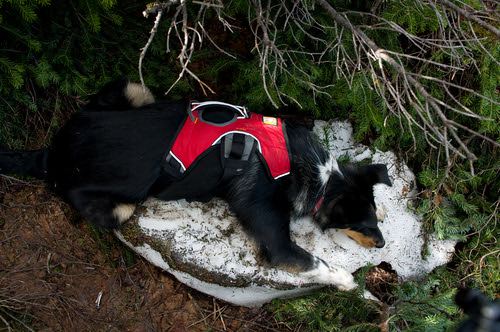
Our Presidential Traverse Summed Up In a Photo!


Although Colvin had been up to Thunderstorm Junction (~5,000ft) just below the summit of Mount Adams this winter, he had never been above treeline in the snow free season. The difference between the two seasons is stark and incomparable. Having had "Wonder Dog" for 10 years I forgot that not all dogs can effortlessly cruise over boulder fields like a mountain goat. Yet, Colvin is actually way ahead of Caney in almost every milestone for a trail dog. He's hiked more miles, spent more days car camping or at a hut, and ascended higher peaks than Caney by almost 9 months! By the end of this summer he'll have paddled at least 200 miles before Caney ever saw the inside of a boat, and he's already done well mountain biking. The only thing Colvin technically hasn't done yet is a backpacking trip, although you could consider his overnight trip to Grey Knob in New Hampshire a backpack.

So my initial disappointment with his fear of negotiating the boulder fields was tempered by the fact that he actually did really well. Caney set a high bar, and it's not reasonable to compare him to any other dog. Caney's FIRST trip to NH he effortlessly summited Mt Jefferson via the 3rd class Ridge of the Caps carrying a loaded backpack without any help whatsoever. Thinking about this in hindsight it is simply remarkable, and now I realize why I was often asked as I hiked above treeline in New Hampshire with Caney what I thought was a stupid question, "how does he do scrambling on the talus?"

To be honest, I never thought Colvin could complete the traverse. When we started planning it I didn't even have him yet, and once we got him I was immediately concerned about the time frame.

Athletically any young Border Collie can hike 20 miles of easy terrain in a day. They have the VO2 max almost 4X that of Lance Armstrong's super human statistic, and were bread for consecuctive 20+ mile days over rough hilly terrain. However, heat, abrasive talus and scree on the paw pads, as well as the mental demands of ascending and descending steep bouldery terrain in 30+ mph winds and 100% humidity, is altogether another factor. At 9 months Colvin is the equivalent of a 14.5 year old child in developmental terms. Putting it into perspective, forgetting the ancillary demands of a 20 mile alpine traverse, not many 14.5 year old humans could handle 16 hours and 18,000ft gain and lost on the trail.

Regardless, as the trip got closer, I gradually started facing reality. I knew his paws at best might hold up for a minimal (summitless) traverse if I protected them with booties. After a while I realized that was probably still unlikely, so I thought we would bail at Mt Washington with or without summiting Adams and Jefferson. Technically, all the elevation gain is over by Mt Washington, and the southern traverse is really just about mileage, but the hike out via the Tuckerman Ravine snowcat trail at the base of Mount Washington is easy enough that I could have carried him out without much difficulty back to Pinkham. Whereas the hike out via the Souther Presidential's is quite a bit more demanding in the descent back to Crawford Notch.

In the end, even that plan was a bit optimistic. However, there is a silver lining, despite dropping my hat and losing a couple of minutes (as in 2 minutes), and then prodding Colvin for almost 2 miles of above treeline hiking, we beat book time from Dolly Copp over the 5,367ft Mount Madison to the AMC Madison Spring Hut by over 20 minutes. Factoring in wind and humidity (creating slick talus and wet paw pads) that is pretty impressive considering Colvin literally started turning around to tell me we should go down at treeline, at times he wouldn't even continue without me going back for him. Basically, when he was moving he was moving pretty quickly.

As we descended Madison it was clear Colvin was mentally frazzled from the stress of rock hopping over and around the jumble of boulders that is the foot path above treeline. Worse, his paws were already showing signs of abuse, and he'd been wearing booties since the start of the descent, which is most rough on the front paws.

At Madison Hut we met back up with Mandy and Kevin who were ahead of us by at least 10 minutes, I raised the white flag. Although it was much less a surrender than the right decision. It was Colvin's hardest single day on the trail (although he actually gained about the same elevation during his winter trip to Grey Knob) and his first 5000ft summit. With the return trip it was just shy of a 10,000ft gain loss day, and just shy of 10 miles. Although he only gets credit for Madison, he essentially did a half traverse.

On the way down we were able to relax, take our time, and enjoy what turned out to be a spectacular day. We spent at least 2 hours just enjoying the day stopping for lunch below the summit and then enjoying the sunshine and clearing views from Osgood Junction for almost an hour!

After our hour long break at Osgood Junction I really wanted to take the Osgood Trail down to the Great Gulf trail, and then the Great Gulf Link trail literally back to our campsite at Dolly Copp. However, as we started on the Osgood I realized the extra 2 miles might be a real issue. Besides that the Osgood continued up and down on the ridge moreso than the Daniel Webster Scout trail which was mostly a straight down descent from the junction. In reality I'm almost certain the Osgood to Great Gulf Link would have been no harder because the Great Gulf Link trail is essentially a double track forest trail for 1.5 miles. Despite that, I couldn't escape the feeling that I was pushing him a little too hard with the extra mileage and we turned around about 5 minutes down the Osgood Trail.

Overall it was a good hike, and nothing to be ashamed of. Colvin was definitely pushed to his limits, he wouldn't even get out of the car Friday night. I had to carry him to the tent, and then feed and water him in the tent because he was too sore to walk on the rough ground.

We picked up Mandy and Kevin at Crawford Notch at 9:20pm. They made excellent time and had absolutely outstanding weather from Mount Adams onward, plus they got a little taste of just how bad an average day above treeline can be in the Northern Presidential's.

Saturday we took a short walk along the river, but Colvin mostly rested in the tent while I tried to dry out our gear from a typical rainy NH/Great Gulf stay. Following the 4.5 hour drive home Saturday night he had enough energy to get his toys out of the bin, and even chase them a few times. Sunday he was ready to play indoors but still tender outside, but I thought a short lowland trail to a lake would be OK. Colvin ended up hiking/bushwhacking about 4 miles and almost did his first swim after playing in the water for about 20 minutes.

Friday, April 30, 2010

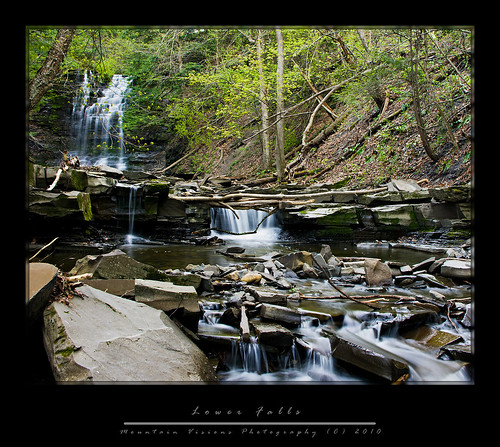
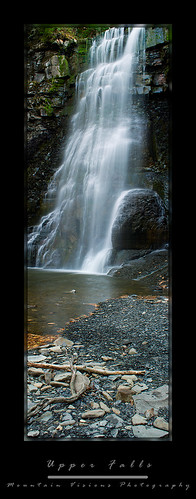
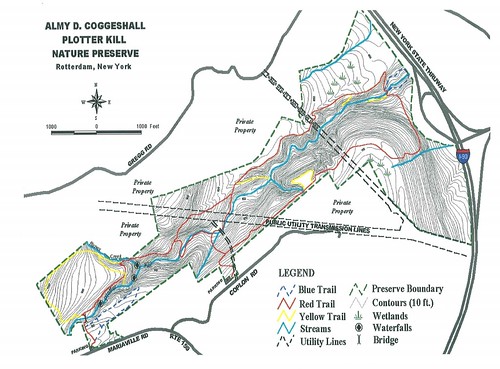
An Afternoon On The Plotters Kill


Just a few images from a very nice -and apparently very popular- little local hike that we'd never done. Of course, just because it's local (18 miles) doesn't mean it's easily accessible. I was in the central Adirondack's a few weekends ago in just a little more time. This isn't uncommon in an area where travel is limited by winding rivers/canals and limited, oft congested crossing points.

Plotters Kill (Flat Creek) is a rugged gorge in Rotterdam Junction, just a few miles from the Rotterdam Square Mall. The waterfalls are mostly seasonal, and already Rynex Creek was almost completely dry, but the Plotters Kill was still flowing nicely.

Still, it's a nice place to explore after work during the summer, or a nice local place to do a little top rope ice climbing during the winter. Although, with the larger Upper Falls being only 60 feet, by the time the base freezes you probably only have about a 45 foot climb. Not insignificant for a local climb minutes from Schenectady, but for a little more driving you can be doing multipitch ice in the Catskills or Adirondacks.


Friday, April 23, 2010

Anything Caney Can Do, I Can Do Better...

...so Colvin told me after our trip to New Hampshire. I reminded him that he had only hiked in the snow and that Caney was probably the best rock climbing canine I'd ever seen.

Two weekends ago was Colvin's first entirely dirt/rock hike up little Buck Mountain on Lake George. The 6 mile hike was technically about as easy as hikes get, with at most some rooted wet trail, but mostly soft dirt and duff. I've actually lobbied to have it renamed Cinderella Mountain since it's directly across Shelving Brook from Sleeping Beauty Mountain. Regardless, other than sore paws from the previous weekend on the granular snow, followed by a 10 mile walk week, and then 4 miles of roller blading on Sunday, Colvin did just fine.

This past weekend we did a creek bushwhack along Stony Creek and Tenant Falls on Saturday, and Sunday we went to Crane Mountain.

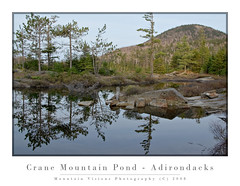
Crane Mountain is a favorite mountain of mine. It's not far from home via the pleasant to drive winding backroads, it's a fairly short circuitous route with multiple options, and an easy bushwhack up a second summit (also with excellent views). And of course it's mildly technical in a few isolated sections, while much of the middle section of trail is a fairly rugged vertical streambed boulder hop. The summit of Crane has some of the best views in all of the Adirondacks, and the
mountain is covered in steep vertical cliffs that yield rock and ice climbing routes of all difficulties. Crane Mountain Pond is also one of the highest altitude bodies of water of substantial size within the Adirondacks.


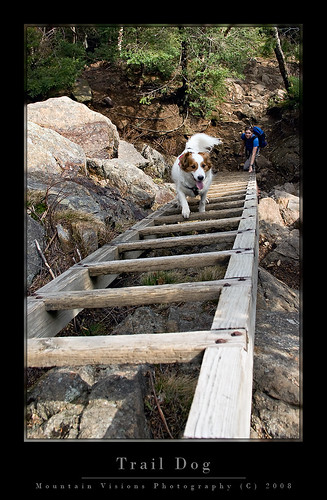
Crane Mountain is easily Colvin's first technical rock hike. There are several very steep sections requiring great care for human hikers with some use of hands. There are also two ladders, the first is about 5 feet high, and the second is about 15-20 feet.

The difference right now between Caney and Colvin as trail dogs is that Caney was very pragmatic about problem solving even at a young age. He was a very good athlete, but just like human climbers, often the best athlete isn't the best climber. Climbing is about problem solving, it's a puzzle with a little gravity thrown in for good measure. Colvin is a superior athlete, but like novice climbers with great athletic skill, he thinks he can power through everything.

On the first very steep technical section, which required using our human hands, Colvin attempted to just jump up and into the overhanging sloped boulders. The result was not so good! He lost his footing and fell several feet, luckily he didn't hurt himself. I lowered the rope to Aimee, she clipped him in, and I hauled him up.

I was certainly hoping for him to flash that first technical section, but it's very easy for me to forget that Caney wasn't necessarily a natural climber, he did take a while to get the confidence to climb challenging terrain better than many humans. Colvin already displays confidence and comfort on the trail, but he definitely lacks the learned skills of technical climbing.

Last Sunday, before we left for Crane, Aim had tweaked her back but was going to give hiking a shot. By the time we'd hiked for a little ways she realized while it was awkard ascending, going down over the rough trail was really going to be agonizing. I wanted to get Colvin as much time out as possible, perhaps even try the first ladder, so Colvin and I hiked up and additional 10 minutes to get past the next 2 hard sections.

Of the two hard sections, the first is a 15 foot fairly steep (near vertical) wall with some lower angled ramping paired with good foot and hand holds, while the second is a 5 foot ladder.

Colvin didn't have any problems on the vertical wall going up or down, but to my surprise, he was surprisingly accepting at giving the ladder a shot. I thought this was odd since he didn't even want to go up the steep loft stairs at Grey Knob. Hopefully this is just a sign of his growing confidence on the trail as he gets more experience.

In any case, he ended up trying to "dyno" the ladder in a few quick bounds, rather than climb it. The result of course was a dog missing the rungs and getting stuck. Thankfully (and unlike Caney) he does tend to listen when he is stressed or excited. I told him to stay, and he relaxed without panicking and throwing himself off the ladder (believe me, if it was Caney he'd never have calmed down). I was able to then give him a boost from above via his Ruff Wear Web Master harness.

The good news of course is he definitely has the desire to climb the ladder, and honestly, Caney was at least a few years old before he willingly climbed his first ladder. It wasn't till he was well aged that he would climb them without prompting. For Colvin to not hesitate is a promising first step. I'm sure as he gets a bit more trail savy, and learns to "climb" up obstacles through problem solving rather than brute force, he will do just fine. When you consider Colvin's progress, it is very impressive considering he has barely hiked 40 mountain trail miles, and only 8 total over only rock/dirt.

I always get a kick when I notice most dog training books consider hiking a non competitive K9 activity, I have to disagree. If you take your dog on challenging trails, it becomes equally competitive as the sport of human rock climbing. Bearing in mind that even if your dog is an agility champion, only you are aware of this achievement. On the flip side, your dog always knows the satisfaction of completing a tough section of trail and continuing on the hike, which then makes the hike itself a continuous reward.