Showing posts with label Ruff Wear. Show all posts

Tuesday, August 13, 2013

Kaaterskill Falls: K-9 on Rappel

Kaaterskill Falls: K-9 on Rappel

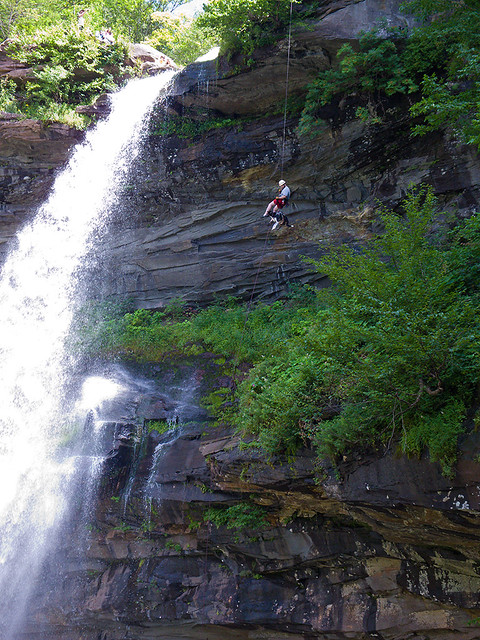
Rappelling at New York's 260ft Kaaterskill Falls. The two tier fall is one of the Catskills hardest pure ice climbs in winter; in summer the 0.4 mile trail to the base is one of the states most popular tourist attractions. 

Colvin and I were practicing rappelling for caving and canyoneering, desensitizing him to the rushing water, spray, and long rappel. 


Ultimately the plan was to rappel directly into the lower pool of water and have Colvin quick release into the water for a swim exit, but the day's plans were interrupted by initially offering assistance and eventually being cleared from the scene of a injured hiker evacuation. 


The day totaled out with two dogs doing 3 rappels, lots of scrambling, and a little excitement in seeing how long it can take to evac an injured person over a half mile of extremely dangerous terrain. A good reminder to double check your setups and be careful when tramping around the mountains, because even a half mile is a long way from help. 


Kaaterskill Falls: K-9 on Rappel from Mountain Visions on Vimeo.


Wednesday, July 27, 2011

K-9 on Rappel

K-9 on rappel

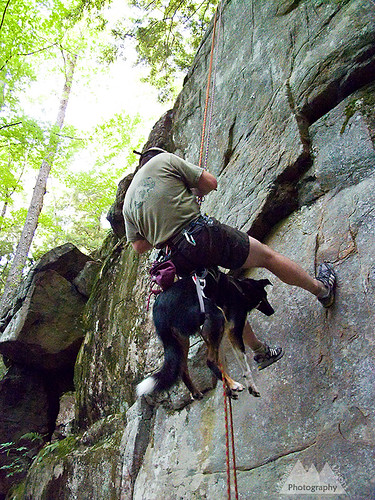
Scared shitless, that would be a good way to describe this. Of course, you are thinking, why the hell would you torment your dog. No, I was scared shitless. Looking down at my harness was a clusterfuck (a climbing term for a mess or log jam) of epic proportions. The only other time my belay loop/tie in point has ever been that busy was while aid climbing. The big difference between this and aiding, Colvin isn't aiders or a haul bag.

I'd planned this day for a while, starting back last Autumn when I re-purchased the Ruffwear Doubleback technical harness. Petzl used to make such a harness, for a fair price at that, then one day they stopped. A fairly recent addition to the Ruff Wear catalog, the Doubleback is the only harness not designed specifically for the needs of search and rescue or SWAT dogs. It's designed to be worn at all times, with hide-away leg loops and a strength rated tie-in point. It's basically a recreational climbing harness for your dog. In theory you could use it as a standard trail harness, but the chest pad and need to "double back" the threaded straps would make it highly inconvenient, and possibly uncomfortable for the dog. Colvin wears his only when I think I might need to rope or haul him.

We used the harness a few times this winter on semi technical terrain, and also hoisted Colvin in it to test the fit and rigging. Outdoors we used it in the Northern Presidential's, on terrain that is often underestimated by novice mountaineers and experienced hikers alike. If the terrain calls for an ice axe and crampons, roping the dog should be a serious consideration. While SAR comes out pretty quickly for humans, I'd prefer not to find out they won't come to rescue a dog. So being extra cautious is important. With this in mind, I practiced short rope techniques with Colvin on a short rope belay. The short rope wasn't really needed due to the conditions not being as snow covered as potentially possible. Still, it was good opportunity to test and refine a technique for more technical terrain when necessary.

I'd taken Caney, my previous trail dog, on the North-South Arapaho traverse (class 3-4/5.0) and up and down various glaciated peaks via snow climbs and scrambles around Lake Isabelle and Triangle Lake in the Indian Peaks; on Central Gully on Mount Washington (WI2, mostly snow), and on various slides, slabs and 4th class scrambles in the Adirondacks. So I know these dogs are capable of going places many choose not to take a dog, but I also know this all comes with a greater responsibility on me. Not only am I responsible for myself, I am also responsible for the dog on very challenging terrain. Practicing under controlled circumstances is the best way to assure everyone is safe.

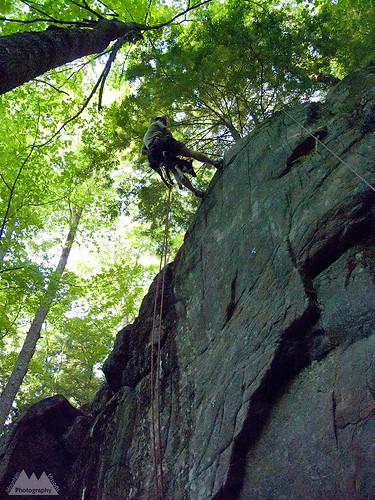
My ideal test place for our first rappel was someplace quiet, secluded, without other climbers. Also preferred was a slightly overhanging face or a free hanging rappel, with high fixed or natural anchors at the top. The Gunks would have done the rock portion of my requirements quite nicely but finding solitude isn't always easy. There was a good chance Colvin would be squeaking and squealing, which he did, as we went over the lip of the cliff. The last thing I wanted to deal with was the cacophony of beta spewing climbers giving unhelpful advice.


K-9 on rappel

Though not well known nationally -due to being in the shadow of the Gunks- the Adirondacks have an immense amount of high quality technical rock climbing routes. And unless you seek out a crowd (the High Peaks roadside options), you will rarely climb with other people. 2,000 routes on 260 separate climbing areas 82 of which offer multi pitch climbing, all spread out over nearly 4 million acres of public land. For this project, Carl's New Baby, a bolted 5.10b on the Hudson River was just perfect.

Petzl Stop. Image: Petzl.com
Safety came in the form of 2 independent but equalized tree anchors about 5 feet from the cliff edge. There was nice clean rock before and over the lip. Aim backed up the first rappel with a top-rope belay topside. The second two rappels she only belayed me over the lip, where the best chance of something going wrong was. In the future I'd probably use a Petzl Gri-Gri, a Petzl Rappel Rack, or perhaps best, a Petzl Stop descender. If nothing else I'd add a carabiner to increase friction.


Petz Rack. Image: Petzl.com
Nevertheless, it took me a while to get everything to where I wanted it, or rather was comfortable with it. Not only was it about being safe, but also making the rappel as comfortable and smooth as possible for Colvin. A bad experience the first time could have left him unwilling to do it again.

Looking at all the anchors (3 in total, two ropes, multiple attachments) it was beginning to look overwhelming. After double, triple, and finally, quadruple checking everything I just said it, "I'm pretty nervous, my heart is pounding." A dog can sense your level of anxiety, and I was hoping to not have been that nervous. Colvin was already attached to my harness, I lifted him up and carried him to the edge, leaned back on my anchor and we were rappelling.

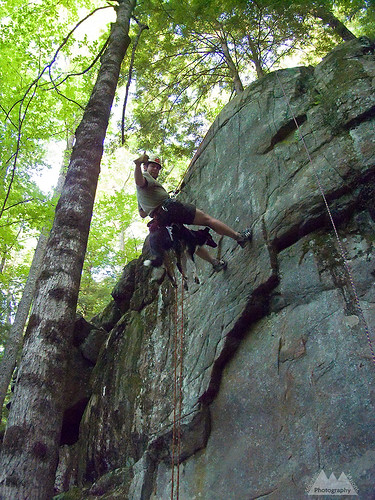
Once the instinct to grab the cliff for dear life was exhausted, Colvin, as with most dogs, gave up and became very calm and still. No squealing, no whimpering, no barking, and no flailing. I'm not sure he was relaxed, it's more a submission than anything, but my anxiety was gone after a few feet of descent.

During the first rappel, Colvin was attached directly by a single locking biner to my belay loop. I've seen this method used by SWAT and fast rope teams, however, he didn't hang far enough down and removing him from the harness was difficult once we touched down. I'd say this method would be better, if I went directly through my rappel biner while on lower angle terrain. Keeping him high on low angle terrain would keep him from bouncing into the rock.

For the second rappel, I used a tripled shoulder length alpine draw, with lockers on both ends to attach Colvin to my harness. I stabilized his rear leg loops with a 4 foot sling that I shortened. The rear loop tie-in isn't required and it's not truly a functional tie-in. What I mean is that it doesn't enhance safety, it's about comfort.  This setup worked pretty well and it seemed like he was in near perfect position, perhaps a few inches lower would have been ideal.

By the third rappel, I was having fun. The anxiety was gone, Colvin was doing awesome, and the setup was just about perfectly refined. Again, I had Aim belay us but just while we were getting setup on the edge. Once we were on the rappel rope and anchor, she was free to take the belay off and snap a few photos.

Aside from not having time to actually climb, it was a hell of a day.

K-9 on rappel

Wednesday, February 23, 2011

Colvin Surveys Cascade and Porter

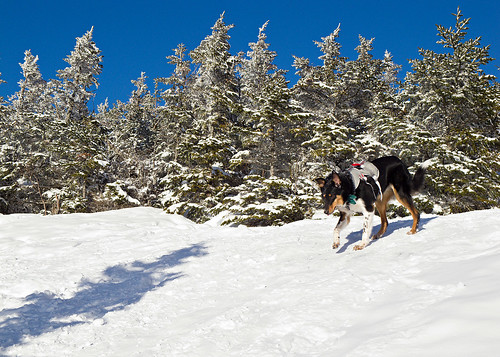
Colvin, wearing a Ruff Wear Doubleback harness, descending Cascade Mountain
Wow, it didn’t occur to me till today that Colvin Harrison had never summited a 46-R. Now don’t think he’s been neglected, it’s not like he hasn’t been up two of the highest peaks in New Hampshire and a (sub) summit of Vermont’s highest peak in the first 9 months he was with us, just none of the Adirondack high peaks from whom his namesake surveyed the Adirondacks over 130 years ago.

So we picked a day when the wind chills were hovering in the -27F (-32C) range, and the ambient temps at or below 0 on the summit for Colvin to summit his first two Adirondack high peaks! Despite the cold, it was actually a beautiful sunny day with perfect snow conditions.
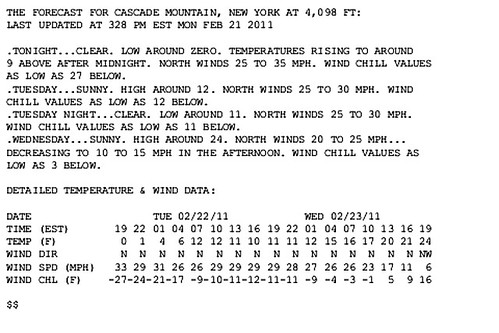
This forecast data is from an experimental NWS weather forecaster out of Burlington, VT. Unfortunately I didn't get a screen shot before we started hiking. Still, winds were forecast in the 30s mph all day, and it actually was trending warmer as the evening progressed. Conditions at 5pm were at least as bad as 7pm.
 
If you have occasionally read this blog, you know I despise the Adirondack High Peaks Wilderness with a passion. That sounds bloody awful, perhaps I should explain (again). I hate the crowds, rules and fees of the Adirondack High Peaks Wilderness, which just happens to be home of the bulk of the high peaks. While I summited several ADK high peaks in the weeks preceding and subsequent to Colvin Harrison’s arrival in New York, he just wasn’t trail ready till late March of 2010. 

Unfortunately, because I was k9less during that time, I was able to use different access points than normal for all the high peaks I summited. The peaks that were in the HPW I reached via the Adirondack Mountain Reserve which is privately owned but accessible to humans (no dogs) via easements. This approach, while not a solitary endeavor, is usually less used than the other access points. 

Then the spring came, and mud season with it. We had planned for him to hike the Colvin Range last spring, but it got pushed off by bad weather, and eventually by paddling season that is a necessary escape from the summer heat and humidity.

So oddly, it was 53 weeks before Colvin reached the summit of his first Adirondack high peak. Originally the Upper and Lower Wolfjaws were planned for various reasons, including solitude and the irony of a dogs first 46-R being the “wolfjaws”, but the closer parking area being unploughed and not wanting to walk in the road (almost no shoulder during the winter with the snow banks) while trucks and cars whizzed by at 55mph, I aborted the Wolfjaws via Deer Brook. And damn the cliche, decided to climb Cascade and Porter, two of the Adirondacks easiest high peaks and often an aspiring 46-Rs first ticks on a checklist. 
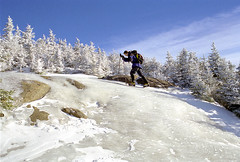

Aim ascending Cascade (Jan 2005)
Cascade is a mere 2.4 miles from the trail head which begins at a lofty 2000ft. Being one of the smallest of the 46-R’s it’s a mere 2000ft ascent. In terms of steepness, it’s pretty mellow. Even the steeper sections aren’t all that steep.  And throwing in Porter adds another 1.4 miles round trip, but a mere 460ft elevation gain/loss over that 1.4 miles. Precisely why Cascade is often the very first high peak people climb.

We arrived at the Cascade/Pitchoff trail head to find it packed. Cascade and Giant Mountain are probably the two most hiked high peaks in the Adirondacks, and on any weekend day you will find both trail heads packed with cars. So I drove towards Lake Placid and stopped at the Cascade ski shop, then we drove up Mountain Road to check out the conditions on the Jack Rabbit trail. Plenty of good quality snow despite the recent heat wave. When we got back to Cascade there were still too many people on the trail, so we took a little nap in the warm sun (yes, direct sun in a car is warm even when it’s around zero outside). 2 hours later the parking areas were thinning out, and we were off. 
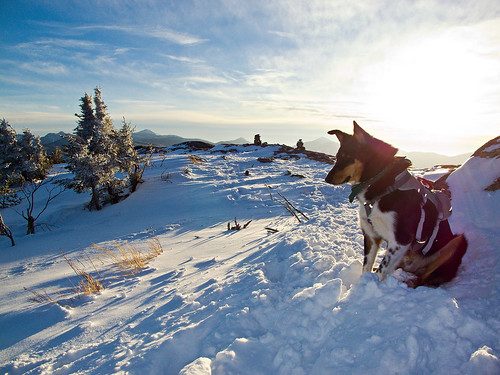
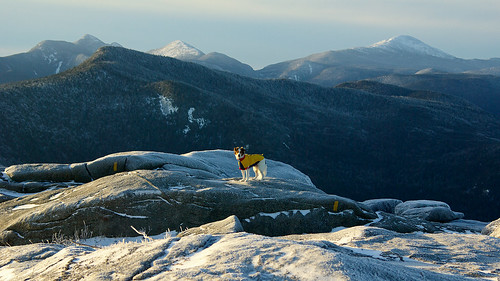
Colvin at a wind break  just below the summit.

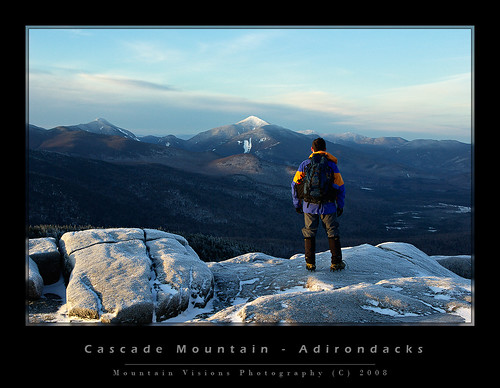
Obviously I was accepting I was going to be sharing the trail with people, unlike the desolate Wolfjaws via Route 73. However, while I was ok with making a deal with the Devil to get a good hike in on a pristine day. I didn’t want to be ascending during an exodus of hikers. Killing a few hours so I could catch the late afternoon light from the summits and only see a few people on the trail was easy enough. If timed just right I wouldn’t even need to use my headlamp. Very rarely are conditions this clear in the Adirondacks, and Cascade is a mountain that lives up to it’s record summit attempts.  You can see 30 of 46 high peaks from it’s completely unbstructed summit and the best time to do so is in the early morning or late afternoon when the mountains really stand out with some depth.
 
Aside from that, I’ve always hiked Cascade either before sunrise or on a weekday. So despite the throngs of hikers that ascend it during peak days, I’ve pretty much always had the upper mountain to myself. Yep, I’ve only seen 2 other people on the summit of Cascade ever


The photographer taking in the early morning light, alone on one of the Adirondacks most hiked peaks (January 2008)

If I had any doubts about the conditions on the summit, I didn’t need verbal verification. The last group of hikers we saw descending were dressed like they were on a winter ascent of Denali, one of the coldest major summits on earth. 
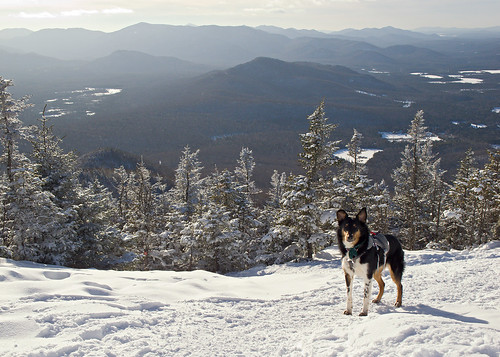
Colvin below the summit

Colvin and I were on the summit of Cascade in about 2 hours which wasn’t bad considering I had to attempt a field repair of a rivet on my MSR Denali. Messing with bolts, washers and nuts in 0F temps is pretty much futile unless it’s life and death -as I write this, it just occurred to me that in 2003 I had a crampon malfunction on Cascade as well.  Eventually I gave up, I ditched the snowshoes below the summit of Cascade.
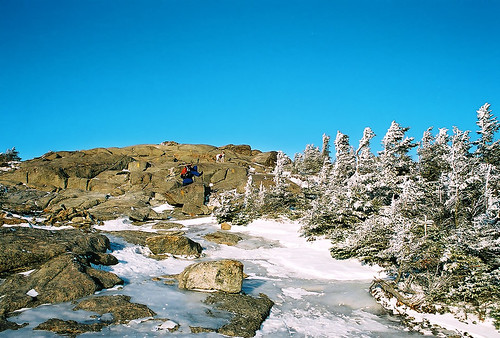
Ascent up the summit slabs (January 2005).

The climb up the summit slabs of Cascade was mostly bare rock with some avoidable ice, only one or two spots would crampons have made things safer, naturally I fell in one of those spots (the safer of the two, and the spot I fully expected to go down) on descent, otherwise bare booted to the summit over the rock, snow and ice without incident.
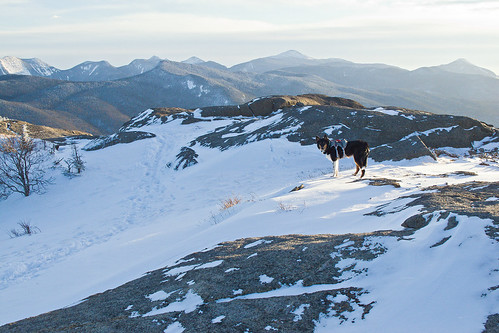
Colvin just feet below the summit as we began our descent.


Caney a few feet ahead of Colvin (January 2008 sunrise) 50mm vs about 105mm, side lit vs. backlit background. Notice the difference in compression and dimension with the telephoto vs the normal lens and the different lighting?

Colvin did great. There was a section I thought he might have problems with, and the wind has never been his favorite force of nature. But he shot up the last .3 of a mile almost effortlessly picking the marked route perfectly unless he saw a better route. I didn’t have to give him an assist or verbal cues up or down. He’s getting much better on the trail and much more confident.
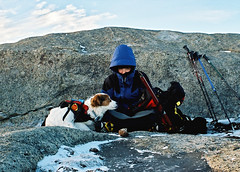
Another cold winter day on Cascade (Jan 2004)
We were both pretty cold when we got back to the Porter intersection, though we both had all our insulating layers in my pack if we needed more heat than movement would provide. I debated not going to Porter, it was already after 5pm, but the trail was well packed and descent would be fast. In the end it was too easy to pass up this BOGO summit. Besides, herding dogs do winter ascents of Cascade as a warm-up before they eat breakfast and tick off a great Range Traverse in the afternoon. Colvin expected more than a measly 4.8 miles, so I put my snowshoes on while Colvin and I snacked and hydrated.

We made quick time to Porter as we tried to warm up. The 1.4 miles round trip took about 30 minutes. We were back at the Cascade intersection by 5:30pm. The 2 mile descent took about 45 minutes sans snowshoes with only a few butt glissades where my bare boots met an icy patch as I jogged down hill. Colvin would see me jogging and sprint ahead full blast, come to a skidding stop in the snow and sprint back up the trail as I continued jogging down. As is typical, he generally hikes/sprints at least 50% more miles than the actual hike requires.

We were back at the car by 6:15p with just enough light to not need the headlamp. 

Total stats for the hike. 2 ADK high peaks, 4600 ft gain/loss over 6.2 miles in 3 hours 30 minutes.  Winds 30mph from the North, 0F ambient, and unlimited visibility. Pretty much a perfect mid winter day!!!  


Friday, April 23, 2010

Anything Caney Can Do, I Can Do Better...

...so Colvin told me after our trip to New Hampshire. I reminded him that he had only hiked in the snow and that Caney was probably the best rock climbing canine I'd ever seen.

Two weekends ago was Colvin's first entirely dirt/rock hike up little Buck Mountain on Lake George. The 6 mile hike was technically about as easy as hikes get, with at most some rooted wet trail, but mostly soft dirt and duff. I've actually lobbied to have it renamed Cinderella Mountain since it's directly across Shelving Brook from Sleeping Beauty Mountain. Regardless, other than sore paws from the previous weekend on the granular snow, followed by a 10 mile walk week, and then 4 miles of roller blading on Sunday, Colvin did just fine.

This past weekend we did a creek bushwhack along Stony Creek and Tenant Falls on Saturday, and Sunday we went to Crane Mountain.
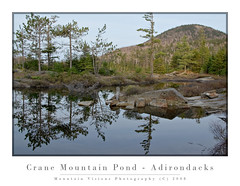
Crane Mountain is a favorite mountain of mine. It's not far from home via the pleasant to drive winding backroads, it's a fairly short circuitous route with multiple options, and an easy bushwhack up a second summit (also with excellent views). And of course it's mildly technical in a few isolated sections, while much of the middle section of trail is a fairly rugged vertical streambed boulder hop. The summit of Crane has some of the best views in all of the Adirondacks, and the
mountain is covered in steep vertical cliffs that yield rock and ice climbing routes of all difficulties. Crane Mountain Pond is also one of the highest altitude bodies of water of substantial size within the Adirondacks.
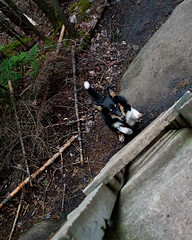


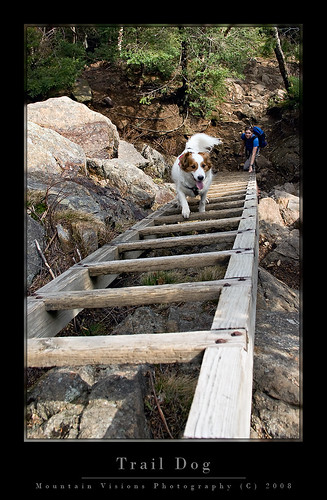
Crane Mountain is easily Colvin's first technical rock hike. There are several very steep sections requiring great care for human hikers with some use of hands. There are also two ladders, the first is about 5 feet high, and the second is about 15-20 feet.

The difference right now between Caney and Colvin as trail dogs is that Caney was very pragmatic about problem solving even at a young age. He was a very good athlete, but just like human climbers, often the best athlete isn't the best climber. Climbing is about problem solving, it's a puzzle with a little gravity thrown in for good measure. Colvin is a superior athlete, but like novice climbers with great athletic skill, he thinks he can power through everything.

On the first very steep technical section, which required using our human hands, Colvin attempted to just jump up and into the overhanging sloped boulders. The result was not so good! He lost his footing and fell several feet, luckily he didn't hurt himself. I lowered the rope to Aimee, she clipped him in, and I hauled him up.

I was certainly hoping for him to flash that first technical section, but it's very easy for me to forget that Caney wasn't necessarily a natural climber, he did take a while to get the confidence to climb challenging terrain better than many humans. Colvin already displays confidence and comfort on the trail, but he definitely lacks the learned skills of technical climbing.

Last Sunday, before we left for Crane, Aim had tweaked her back but was going to give hiking a shot. By the time we'd hiked for a little ways she realized while it was awkard ascending, going down over the rough trail was really going to be agonizing. I wanted to get Colvin as much time out as possible, perhaps even try the first ladder, so Colvin and I hiked up and additional 10 minutes to get past the next 2 hard sections.

Of the two hard sections, the first is a 15 foot fairly steep (near vertical) wall with some lower angled ramping paired with good foot and hand holds, while the second is a 5 foot ladder.

Colvin didn't have any problems on the vertical wall going up or down, but to my surprise, he was surprisingly accepting at giving the ladder a shot. I thought this was odd since he didn't even want to go up the steep loft stairs at Grey Knob. Hopefully this is just a sign of his growing confidence on the trail as he gets more experience.
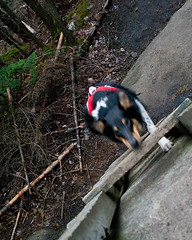
In any case, he ended up trying to "dyno" the ladder in a few quick bounds, rather than climb it. The result of course was a dog missing the rungs and getting stuck. Thankfully (and unlike Caney) he does tend to listen when he is stressed or excited. I told him to stay, and he relaxed without panicking and throwing himself off the ladder (believe me, if it was Caney he'd never have calmed down). I was able to then give him a boost from above via his Ruff Wear Web Master harness.

The good news of course is he definitely has the desire to climb the ladder, and honestly, Caney was at least a few years old before he willingly climbed his first ladder. It wasn't till he was well aged that he would climb them without prompting. For Colvin to not hesitate is a promising first step. I'm sure as he gets a bit more trail savy, and learns to "climb" up obstacles through problem solving rather than brute force, he will do just fine. When you consider Colvin's progress, it is very impressive considering he has barely hiked 40 mountain trail miles, and only 8 total over only rock/dirt.

I always get a kick when I notice most dog training books consider hiking a non competitive K9 activity, I have to disagree. If you take your dog on challenging trails, it becomes equally competitive as the sport of human rock climbing. Bearing in mind that even if your dog is an agility champion, only you are aware of this achievement. On the flip side, your dog always knows the satisfaction of completing a tough section of trail and continuing on the hike, which then makes the hike itself a continuous reward.