
Showing posts with label Adirondack Council. Show all posts

Wednesday, June 9, 2010

Legislature Successfully Defends Paterson's Assualt On EPF

The following is not without some negative. The legislature did in some ways gut the EPF, but it didn't allow David A. Paterson to milk the EPF to cover his shortcomings as a leader. The legislature prevented him from using the EPF as a rainy day fund for the states day to day expenses, which was his initial goal.

The bottom line was that they cut about $78 million out of the EPF to fund the $11 million it (supposedly) cost to reopen the state parks and campgrounds that were closed.

I'm the first one to admit I'm not super smooth at math, but something isn't right. Basically Paterson held the NY State Parks as hostages while he demanded the funds from the EPF. So what he did was he said, the park system, which saw record visitation last year (and I'll assume near record revenue, or I'll again assume probably broke even in expenses) was too expensive to run, so if the legislature wanted to appease it's constituents it would have to deal the EPF.

See, unlike most of the Forest Preserve or the EPF, people and towns feel the crunch of the park closures instantly. It really hits home. Paterson tossed a grenade into the assembly and senate chambers and waited for someone to dive on it. Of course, there probably isn't one upstanding human being in the legislature, so they did the only thing they could, they tossed the EPF on it to save themselves.

Paterson is gutless, he's potentially a moron, but someone smart is pulling the puppet strings behind this guy. This was a move Joe "Prison Bound" Bruno would have been proud of.

Regardless, it's good to see New York State politics remain as corrupt as when Theodore Roosevelt literally had to break a leg off a chair to defend himself on the floor of the state capitol because he was one of just a few members of our government who would not tolerate the corrupt antics of our law makers.


ALBANY, N.Y. – The Adirondack Council today thanked the leaders of the NYS Senate and Assembly for standing up to a flurry of attacks on the NYS Environmental Protection Fund (EPF) proposed by Gov. David Paterson during this year’s budget negotiations.

Legislators today passed bills agreed to yesterday with Gov. Paterson that would reopen the state parks, historic sites and campgrounds closed by the Governor, while also preserving the funding and traditional spending priorities of the EPF.

While the overall spending levels for the EPF for FY 2010-11 are lower than the organization had hoped, the group praised the two Environmental Conservation committee Chairmen (Sen. Antoine Thompson of Buffalo and Assemblyman Robert Sweeney of Lindenhurst), as well as Senate Conference Leader John Sampson and Assembly Speaker Sheldon Silver, for making numerous improvements to the EPF in light of a $9 billion budget deficit.

“Today’s legislation would preserve the reliable funding source and the integrity of the Environmental Protection Fund, while reopening the state’s parks and campgrounds before the Memorial Day weekend,” said Brian L. Houseal, Executive Director of the Adirondack Council. “It would also allow the state to live up to some of its existing commitments to purchase and protect critical lands and waters that have been identified by the public for their recreational and ecological importance.”

The EPF’s 2010-11 total funding will be $134 million, down significantly from $222 million last year. The open space account for 2010-11 contains $17.6 million, much less than the $60 million from 2009-10, but it also rescinds Governor Paterson’s proposed moratorium on land protection. It is our understanding that the Governor has agreed to spend this money on land protection projects that the Legislature has allocated.

Not included in the EPF’s expenses are $11 million the Governor had proposed for paying state employees and day-to-day expenses at parks and historic sites. Also not included in the EPF’s expenses are $5 million for a portion of the state’s payment of taxes to local governments for state-owned land across the state. Both of those expenses are due to come from the state budget’s General Fund, as they have in past years.

“Legislative leaders recognize that all New Yorkers need clean air, clean water and safe places to play. We also need the tourism revenue that our parks, campgrounds and Forest Preserves and other open spaces provide to our citizens,” Houseal said. “We are grateful that they did so much to improve on the Governor’s plan.”

The EPF was created in 1993 and is funded primarily through a small Real Estate Transfer fee, to fund major environmental expenses. Eligible projects include municipal landfill closure, purchase and construction of recycling facilities and transfer stations; as well as the purchase of new lands and parks for environmental protection, recreation and historic preservation.

The EPF is a capital-projects-only fund, to ensure that its revenues would not be siphoned into paying day-to-day expenses, such as state employee salaries and benefits.

“If state agencies were allowed to pay their employees out of the EPF account, the EPF would be dry in just a few years,” Houseal explained. “We would never fund another capital project out of it. We’d be right back to borrowing for everything. Nobody wants that.”

“Governor Paterson followed the lead of his predecessors and tried to use the EPF to pay for staff and other administrative expenses,” Houseal said. “He wanted to change the very structure of the EPF. We are pleased the Legislature said ‘no.’”

The final agreement on the EPF passed both houses earlier today. The Assembly passed the bill by a vote of 86-47 just before 3 AM early Friday morning. The Senate passed the bill by a vote of 32-27 at 2:30 PM.

The Adirondack Council’s mission is to ensure the ecological integrity and wild character of the Adirondack Park. Founded in 1975, the Council is a privately funded not-for-profit organization with 18,000 members in all 50 United States. The Council carries out its mission through research, education, advocacy and legal action.


Additional comments on the "poisoned pill" compromise:


Land state should buy isn’t all in Ad’ks


To the editor:

In regard to your June 3 editorial ("This year, of all years, NY can't afford land"), it is critically important that Daily Enterprise readers understand that the Environmental Protection Fund preserves sensitive habitat, not just in the Adirondacks but around the state.

While the North County is blessed with abundant nature and open space, such is not the case in more crowded areas like the Hudson Valley and Long Island. For example, in the Long Island Pine Barrens - a sensitive ecosystem that protects clean drinking water for thousands of people - the threat of development is not simply an aesthetic one.

Conservationists have been in discussions with land owners in the Pine Barrens for years, in an effort to convince them not to sell out to another strip mall or subdivision. When Gov. Paterson threatened to suspend all habitat purchases earlier this year, the threat of defunding the open space line of the EPF nearly derailed negotiations and put the public's well being at risk.

Your criticism about very modest open space funding would be better directed at the cynical political process that gutted the Environmental Protection Fund in its entirety. By hiding a massive EPF cut in the bill that reopened state parks, Albany legislators slipped in a "poison pill" that truly shortchanged New York's treasured natural heritage.

We encourage Daily Enterprise readers who hunt, fish and otherwise enjoy the area's natural splendors to find out how their Albany representatives voted on environmental funding this year - and keep that information in mind when they go to vote next fall.Marcia Bystryn, president

New York League of Conservation Voters

via: Adirondack Daily Enterprise
Wednesday, March 24, 2010

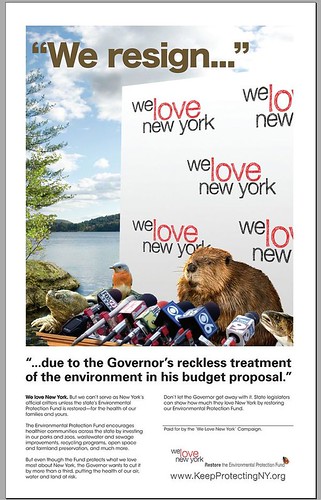
Official NY State Fauna Resign In Protest To EPF Cuts


As Governor David Paterson continues to gut New York State environmental funding, the official state animals have handed in letters of resignation in protest to the reduction of the states environmental protection fund (EPF).

This is a move of obvious futility as these animals were out of jobs, homes, and food sources regardless, but the symbolism of the move should not be taken lightly.

The following are some Tweets from our faithful state fauna:


On a more serious note, why should you care if the EPF is slashed to horrendously low levels on top of the DEC cuts? Like the DEC the EPF isn't just about wild lands, and just like my previous post about the DEC and it's role, the EPF winds up benefiting every family in New York whether they care or not. Some things are kinda like the light switch, you don't really care how it works or why it works, and you take for granted it does work right up till it doesn't work. That is the EPF!

The EPF is designed to protect wild land by buying it before it's developed. It also protects farmland and cleans up waste sites. You know that battery factory in your town that is seeping waste into your water supply? The EPF takes care of that problem so your children are born with somewhere around 10 fingers and 10 toes.

Now as far as farmland, I realize most urban New Yorker's really never thought about where their food comes from unless they are label readers, but most of your food actually comes from the state you live in. New York is a top 10 agricultural state in many areas, and in quite a few it's a top 5.

Imagine if all your food was trucked in from California or Florida how much it would cost? Luckily it doesn't have to be because you live in a state with fertile farmland. Even your "local" Walmart started to realize it could save more money buying local than it could buying solely in bulk when gas prices hit $4-5 a gallon. There is no guarantee that gas won't again hit that, and remember how much your food went up over that stretch!

So part of the EPF is protecting your food sources and cost, I bet you didn't realize that.

Interestingly, if the EPF suffers long term cuts it is speculated that this could put New York's not so long term ability to be an agricultural leader in jeopardy. So what you might ask? Well, I did note that New York was a top 10 agri state in almost every area of food production, imagine we knock our food production down across the board not only in New York but in all states, and allow our farmland to be turned into malls, housing developments, car dealerships, more unfilled retail space, etc. That all sounds good, but where do you think our food will come from?

Putting it another way, what is the United States biggest asset? Our ability to not only feed ourselves, but at times other parts of the world with excess for capacity. What would happen if the United States was no longer the most powerful agricultural nation in the world? What would happen if we could no longer feed our own nation?

Let me analogize this, one day, within 20 years in fact, it might be possible that we are as enslaved for our food as we are for our oil based energy grid and transportation systems. How do you feel about that?

Chenango County Agriculture and Farmland Protection Board Chairman Don Franklin said if things don’t improve for the ag industry soon, the entire country could lack enough food in about 20 years.

“If we don’t keep ag viable ... if we don’t, I’m afraid to say that in 20 years down the road we are going to be facing a problem that we’ve never faced before. It’s going to be hunger,” he said.

Franklin is a former farmer and once served as a county supervisor. He was on hand at a meeting of the Agriculture, Buildings and Grounds Committee on Monday to ramp up support for two resolutions that would urge state lawmakers to support New York’s dairy farmers.

...

The EPF faces a $69 million cut under Gov. David A. Paterson's 2010-2011 Executive Budget. A “No Farms No Food” rally was held on Wednesday in the state’s capitol to convince the Legislature to restore funding to previous levels.

-- Melissa deCordova, The Evening Sun (Chenango County)


In the age of consumerism people might have lost sight of the fact that water and food are still important things. The EPF assures that you have clean water and abundant food, which are still essential for human life and prosperity.

Once again, we need to contact people that count on our votes to do the right thing. Our farmland is a non renewable natural resource, once we use it up it is gone. New York is blessed to be not only a financial and cultural leader of the world, we are also an environmental and agricultural leader as well. So let your representatives know that we aren't going to stand for reductions in the long term safety and security of our state.


For more information:


http://www.keepprotectingny.org/


To contact your legislator:

http://assembly.state.ny.us/

http://www.nysenate.gov/


Saturday, April 25, 2009

Ending Midwestern Eco-terror On The Adirondacks


Acid rain is all too real in the Adirondacks which are not known for their deep soil, or the ability to absorb pollutants. The soil in the Adirondacks is notorious for being thin and lacking nutrients. The Algonquins were called bark eaters because of the inability to farm in the Adirondacks. Anyone who doubts the depth of Adirondack soil on the mountain sides only needs to look at the mountain faces that frequently give way to landslides after heavy rainfall. Heavy rain causes a rather positive recreational phenomenon known as a "slide." These slides after a few years offer unobstructed views, technical climbing, and in winter incredible backcountry skiing. Of course this is perhaps the only positive of having thin soil in a world filled with pollution.

It seems is recent evidence showing that due to global climate change soils in general are less able to hold onto pollutants, and nutrient replenishment has been slowed. Acid rain leeches the nutrients which then kills off the trees. Once the trees are gone soil is more likely to erode, and without soil to filter the acids they end up in our water.


Despite NY being one of the more forward thinking states on conservation, midwest acid rain has done a great deal of damage to our well protected forest. Unfortunately, the Midwest has no plans to regulate itself!

With a little luck in passage of the bill discussed below, New Yorks otherwise clean and well protected mountain lakes will once again thrive.


Central New York Rep. John McHugh takes aim at acid rain

by Mark Weiner / The Post-Standard
Thursday April 23, 2009, 6:27 AM

Washington -- A Central New York congressman, seeing an opportunity that may never come again, has introduced a bill requiring the most drastic cuts in U.S. history to the pollution responsible for acid rain.

Rep. John McHugh said he wants to tie his "Acid Rain and Mercury Control Act" into a landmark energy and climate change bill that Congress will begin considering this week, with the goal of a vote by June.

The climate legislation to control greenhouse gases received a boost last week when the U.S. Environmental Protection Agency ruled that global warming is a danger to public health and welfare.

The EPA's action sets the stage for the federal government to regulate carbon dioxide pollution and five other greenhouse gases linked to climate change.

New York's Adirondack and Catskill mountains are particularly hard hit because their soils are more sensitive to acid rain than any other place in the nation.

Studies have shown that about 40 percent of Adirondack lakes are either always or sometimes acidic. Up to 25 percent of the lakes surveyed have been declared essentially dead, supporting no fish life.

To address the problem, the McHugh bill would:

• Require power plants to make a 90 percent reduction in mercury emissions from current levels by 2013.

• Require a 75 percent cut in sulfur and nitrogen emissions from 1997 levels by 2012.

• Authorize $13.6 million per year through fiscal year 2018 to implement the requirements of the legislation.

• Allow power plant owners to use market-oriented mechanisms to comply with the new standards, such as trading in pollution credits.

• Prohibit any trading of mercury pollution credits, placing an unmovable limit on mercury emissions from individual power plants.

The congressman's proposal received immediate praise from New York state environmental groups and independent scientists who study acid rain.

"I think this is as aggressive a proposal as I have ever seen," said Syracuse University professor Charles Driscoll, one of the nation's leading acid rain scientists.

Driscoll said the timing of the proposed federal legislation on both climate change and acid rain is important because recent studies show that under higher temperatures soils are less able to retain nitrogen, which leaches into water as nitric acid.

"I think there is some urgency," Driscoll said. "It looks like there are some interactions to climate and acid rain.

The Adirondack Council, the largest advocacy group for the 6 million-acre Adirondack Park, agrees with McHugh that momentum could be strong enough in Congress to finally pass acid rain legislation.

John Sheehan, speaking for the Adirondack Council, said the prospects changed when President Obama took office and expressed his commitment to climate change legislation.

"I am most interested in ensuring that, however these issues go forward, that acid rain is part of the discussion," McHugh said. "The bill is intended as a reference tool, so if somebody asks what we should be doing, we have a bill that has already been printed up and is ready to go."

Full article can be found here.
Blogged with the Flock Browser